

Wilderness Swimming Gear for Outdoor Survivalists

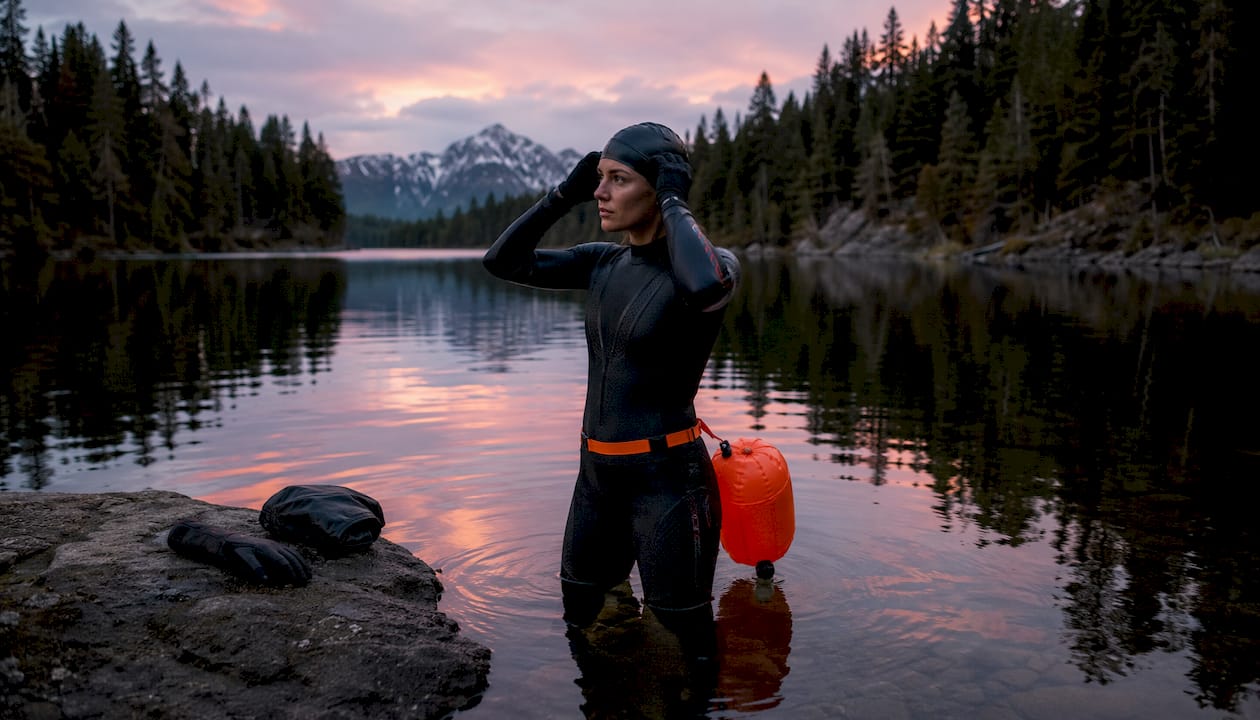
For any wilderness swim, river crossing, or cold-water emergency, your core swimming gear comes down to five items: a high-visibility swim buoy, a quick-dry thermal layer or 3mm neoprene wetsuit, a pair of sealed goggles, a waterproof dry bag, and a compact signaling device.
Here’s why each one earns its spot:
High-visibility swim buoy — keeps you visible to rescuers and acts as a flotation aid; USCG guidance consistently emphasizes visibility as the first line of survival in open water
Neoprene wetsuit or thermal layer — 3mm neoprene is a commonly recommended thickness for water considered cold; it helps extend safe exposure time before hypothermia risk rises
Sealed goggles — protect your eyes from silt, bacteria, and debris in natural water; clear vision is a safety asset, not a comfort upgrade
Waterproof dry bag — doubles as a float, keeps fire-starting gear and clothing dry, and compresses to almost nothing when empty
Signaling device — a whistle or compact mirror; both weigh under an ounce and can summon help when your voice can’t carry
Pro Tip: Thrillofit contributors field-test gear in real wilderness conditions. One consistent finding: a swim buoy that doubles as a dry bag cuts pack weight and gives you two critical functions in one item.
Table of Contents
What swimming gear do you actually need by scenario?
The right kit shifts significantly based on where and why you’re swimming. Cold mountain lakes, fast-moving rivers, and warm basecamp ponds each demand a different approach.
Scenario | Best for | Warmth/Insulation | Packability/Weight | Durability | Visibility/Safety | Typical Price Range |
Cold-water swim (60–70°F) | Alpine lakes, early-season crossings | 3–5mm neoprene wetsuit | Moderate (bulky but compressible) | High if rinsed after use | Bright-colored wetsuit + buoy | — |
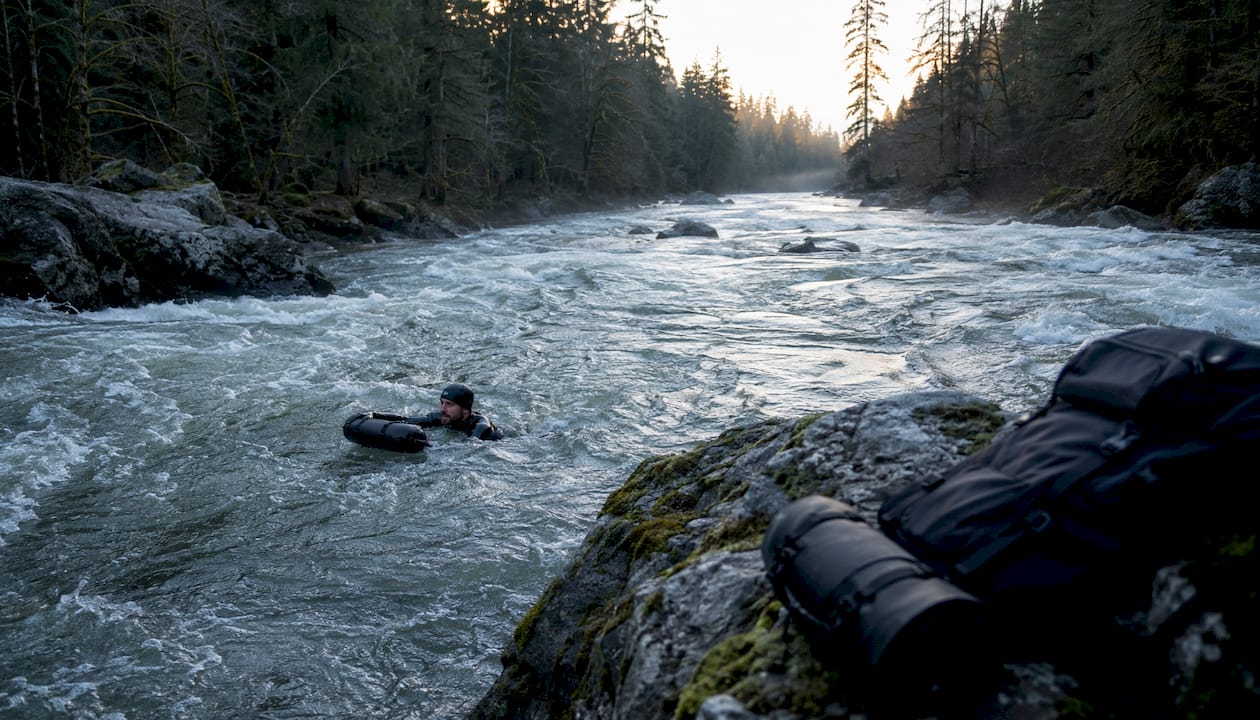
River crossing/whitewater | Fast current, technical terrain | Thin neoprene or quick-dry layer | High (lightweight layers) | Medium (abrasion risk) | High-vis buoy, whistle mandatory | — |
Warm lake/camp swim | Summer basecamp, slow water | Quick-dry polyester training suit | Very high (packs flat) | High with polyester/PBT blend | Buoy optional, cap recommended | — |
Cold water is where most wilderness swimmers underestimate risk. A 3mm wetsuit in cold water significantly extends your functional swim time compared to no insulation. For river crossings, the priority flips: you want freedom of movement over insulation, which means a thin neoprene top or a quick-dry training suit paired with a high-vis buoy clipped to your pack. Warm lake swims at basecamp are the one scenario where a simple polyester training suit and silicone cap cover the basics.
Pro Tip: Performance suits are engineered to fit like a second skin on land. If you need full mobility for a river crossing, size up from competitive sizing — the suit loosens slightly in water and you’ll move far more freely.
How do you choose each piece of essential swimming equipment?
Buying the wrong item once in the field is an expensive lesson. Here’s what to check before you commit.
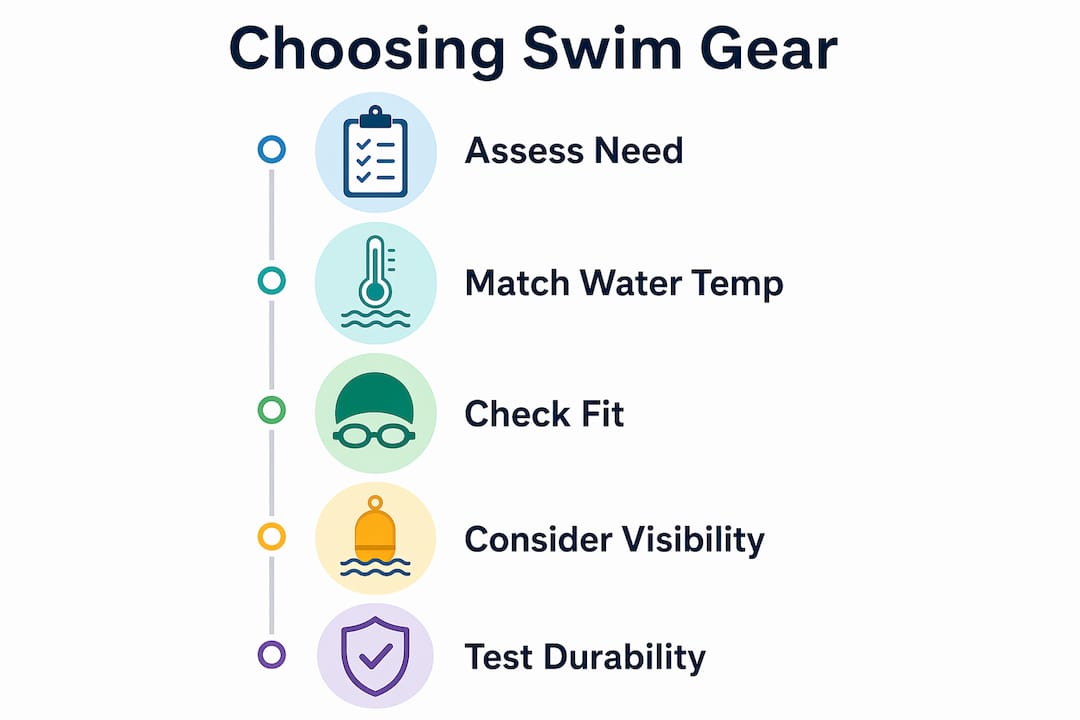
Goggles: Press them to your eye sockets without the strap. A brief suction that holds for a few seconds means a likely leak-free fit. Skip any pair that drops immediately. For wilderness use, prioritize wide-lens models with UV protection and anti-fog coating.
Swimwear: Performance fabrics built from polyester or PBT blends resist chlorine degradation, hold shape across hundreds of sessions, and dry faster than elastane-heavy suits. Casual beachwear breaks down quickly in freshwater and saltwater alike. For river crossings, avoid baggy cuts — excess fabric creates drag and can snag on submerged obstacles.
Neoprene: Match thickness to water temperature. 3mm works for 60–70°F; 5mm for anything colder. Check seam construction: glued-and-blind-stitched seams hold heat better than flatlock. Avoid suits with exposed neoprene on high-abrasion zones like knees and elbows if you’re crossing rocky terrain.
Swim buoy/dry bag combo: Look for at least Sufficient capacity for carrying essentials securely, with a reliable roll-top seal for waterproofing, and a tow line long enough to keep the buoy behind you without tangling your kick.
Signaling tools: A Fox 40 pealess whistle or a compact signal mirror. Both are USCG-recommended for open-water use. Avoid whistle designs with peas — they clog with debris and fail when wet.
Red flags to skip: non-chlorine-resistant fabrics for any regular freshwater use; oversized suits that billow during crossings; goggles with foam gaskets (they absorb water and degrade fast outdoors)
Prioritize flyback or cross-back suit cuts for high-stress movements; they stay in place under load
How to care for and repair your swim kit in the field
Wet gear left unmanaged in camp is a hypothermia risk, not just a gear problem. Handle it immediately after every swim.
Rinse with fresh water as soon as possible. Silt, salt, and biological matter accelerate fabric and neoprene breakdown.
Wring out and hang to air-dry in a shaded, ventilated spot. Direct sun degrades neoprene faster than water does.
Stuff goggles with a dry cloth to absorb interior moisture and prevent lens fogging on the next use.
Patch neoprene tears immediately. Duct tape holds for a day or two; neoprene cement (Aquaseal or equivalent) is a permanent field fix. Apply to a clean, dry surface and allow 12 hours to cure if possible.
Sanitize gear used in silty or stagnant water. A diluted iodine rinse or a small amount of camp soap reduces bacterial load. Dry completely before packing — damp neoprene stored in a sealed bag breeds mold fast.
Pro Tip: For emergency anti-fog on goggles, a small dab of baby shampoo or even a drop of saliva rubbed across the lens and rinsed lightly works in the field. Carry a 1oz bottle of baby shampoo in your kit.
What does a minimal ultralight swim kit actually weigh?
Two variants, built for different priorities:
Minimal kit (durability first):
3mm neoprene wetsuit top: moderate weight and typical affordable price range
Polyester/PBT training suit: lightweight and budget-friendly
Sealed goggles: light and affordable
Silicone swim cap: very light and inexpensive
Dry bag/swim buoy combo: moderate weight and cost
Pealess whistle: extremely light and low cost
Ultralight kit (weight first):
Quick-dry rash guard (polyester): lightweight and reasonably priced
Minimal-cut training suit: light and moderately priced
Lightweight goggles: light and affordable
Silicone cap: very lightweight and low-cost
Packable dry bag with smaller capacity: very light and affordable
Whistle: very light and inexpensive
Compress neoprene by rolling it tightly from the ankle up, then securing with a rubber band. Nest goggles inside the rolled suit to protect the lenses. A buoy/dry bag combo eliminates one item entirely.
What safety steps matter most for wilderness swimming?
Prevention is the whole game. Most wilderness swimming emergencies are avoidable with a pre-swim checklist.
Before entering any natural water:
Scout the crossing from the bank. Identify exit points downstream before you enter.
Unbuckle your pack hip belt and loosen shoulder straps so you can ditch it if you go under.
Clip your swim buoy to your wrist or tow line, not your pack.
Designate a shore-based spotter if you have a partner.
Check water temperature. Below 60°F, limit unprotected exposure to under 10 minutes.
If you get into trouble:
Float on your back to conserve heat and energy. Fight the urge to thrash.
Activate your signaling device immediately — three whistle blasts is the universal distress signal.
Angle toward the bank using a ferry-glide position in current; swim at 45 degrees to the flow, not directly against it.
If a partner is present, extend a tow line, trekking pole, or clothing item — never enter fast water to make a direct rescue unless you are trained and tethered.
Hypothermia triage: Shivering is early-stage and manageable. Get the swimmer out of wet gear, into dry insulating layers, and horizontal. Use an emergency blanket to reflect body heat. If shivering stops and the swimmer becomes confused or lethargic, that’s a medical emergency requiring evacuation.
High-visibility open-water safety buoys are designed to balance flotation with minimal drag, so there’s no excuse to leave one behind on a wilderness trip.
Where do you buy reliable swim gear in the US?
The US market has solid options across price points. The key is knowing which category to buy from and how to test before you commit.
Category | Why it fits a survival kit | Where to buy in the US |
Wetsuits/neoprene | Insulation, buoyancy, abrasion protection | Specialty outdoor retailers, dive shops |
Quick-dry polyester training suits | Packability, durability, fast drying | SwimOutlet, TYR, Speedo US |
High-visibility swim buoys | Visibility, flotation, dry storage | SwimOutlet, outdoor outfitters |
Dry bags (packable) | Equipment protection, emergency float | REI, Amazon, outdoor gear shops |
Goggles (sealed, UV-rated) | Eye protection, visibility in natural water | TYR US, SwimOutlet, specialty retailers |
Try goggles in-store using the suction test before buying; most specialty retailers allow it
For wetsuits, visit a dive shop or outdoor outfitter with fitting rooms — neoprene sizing varies significantly by brand
Use return policies strategically: buy two suit sizes, test in a pool or shallow water, return the one that doesn’t fit
Training suits with polyester/PBT blends outlast elastane-heavy suits by a wide margin in natural water conditions
Key Takeaways
The most effective wilderness swimming kit prioritizes visibility, insulation, and packability — in that order — with every item pulling double duty where possible.
Point | Details |
Prioritize visibility first | A high-vis swim buoy doubles as a dry bag and is your most critical safety item in open water. |
Match insulation to water temp | Use 3mm neoprene below 65°F; quick-dry polyester suits handle warm-water camp swims. |
Test goggles before you buy | Press them to your eye sockets — a brief suction hold means a leak-free fit in the field. |
Choose polyester/PBT fabrics | These blends resist chlorine and freshwater degradation far longer than elastane-heavy suits. |
Field-repair immediately | Patch neoprene tears with neoprene cement; sanitize gear used in silty water before repacking. |
What most wilderness swimmers get wrong about their kit
Most outdoor enthusiasts treat swimming gear as an afterthought — something grabbed from the back of a closet rather than chosen with the same care as a shelter or fire kit. That’s a mistake with real consequences.
The piece of kit people consistently underestimate is the swim buoy. It’s not a triathlon accessory. In a wilderness context, it’s a signaling device, a flotation aid, and a dry bag for your fire kit, all in one. Leaving it behind because it “looks like a pool toy” is the kind of reasoning that gets people in trouble in fast water.
The other gap I see repeatedly: people buy the wrong swimwear for natural water. Casual beachwear degrades fast in freshwater and saltwater, loses its shape, and offers no insulation. A polyester training suit costs $30 and lasts years. The math isn’t complicated.
If you’re serious about wilderness water crossings, spend 20 minutes practicing a shallow-water self-rescue before you need it. Gear is only as useful as your ability to use it under stress. Thrillofit’s guides on scuba diving certification cover related breath control and water confidence skills worth building before any serious open-water crossing.
Useful sources for further reading
TYR Swim Accessories — silicone caps, goggles, ear plugs, and fins built to performance standards; useful for accessory specs and sizing
SwimOutlet Swim Gear — broad US retail catalog covering goggles, fins, pull buoys, and open-water safety gear
Speedo US Training Suits — polyester/PBT Endurance+ fabric specs and competitive sizing guidance
What Is Performance Swimwear? — material breakdown comparing polyester/PBT vs elastane for durability and chlorine resistance
The Ultimate Guide to Swimming Gear — covers goggle fit testing, swimwear selection, and accessory basics (UK-based, but material guidance applies universally)
THEMAGIC5 Swim Accessories — open-water safety buoys, thermal caps, and training tools with notes on visibility and hydrodynamics
Arena Swim Training Tools — fins, kickboards, snorkels, and paddles for technique work and open-water prep
Recommended
Comments